Showing posts with label newsletter. Show all posts

Wednesday, August 14, 2013

My newsletter: catching up on issues from July 2013, April 2013 and January 2013

Some of you may have followed my newsletter by subscribing, but here is a quick run-down of the issues I have published since my unintentional disappearance from the blogging world. More later on how my temporary absence lead to nearly 10 months of silence.

Click here to read the July 2013 issue of The Laboratorian.
  • Lab Tour: Specimen Acquisition
  • Celebrating the 50th Anniversary of Newborn Screening
  • Laboratory Response Network: Texas Style


Click here to read the April 2013 issue of The Laboratorian.
  • Lab Tour: Consumer Microbiology
  • Newborn Screening 50th Anniversary Celebrations
  • The Question of Mutual Tuberculosis Transmission


Click here to read the January 2013 issue of The Laboratorian.
  • DSHS Laboratory Celebrates New Life-Saving Test for Newborns
  • Laboratory Aids in Fungal Meningitis Outbreak
  • Celebrating Immunizations

Wednesday, October 17, 2012

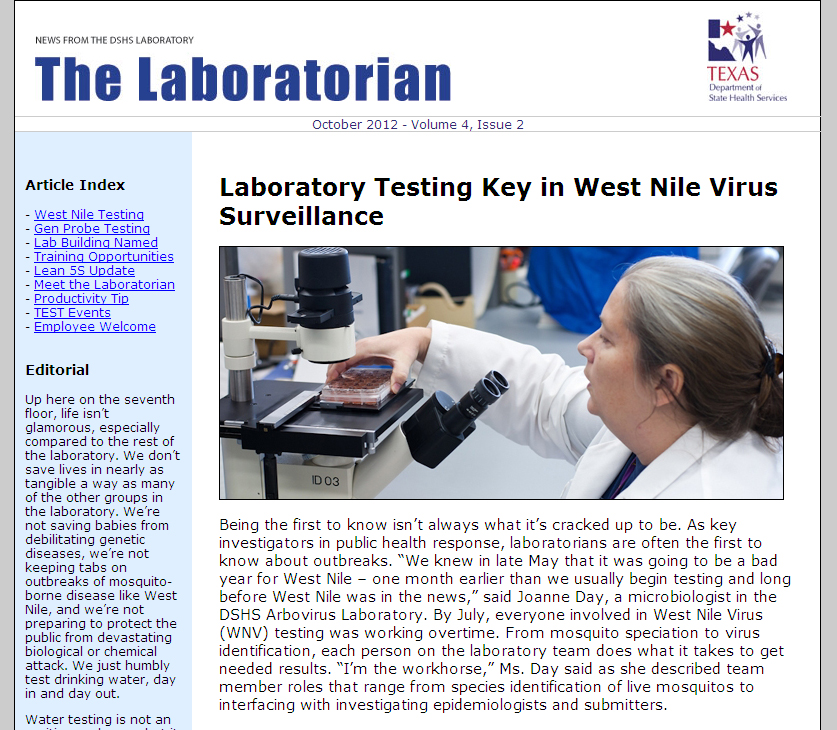
My Newsletter: West Nile Virus, Gen Probe testing, and new building name

Click here to read the October 2012 issue of The Laboratorian.

"Laboratory Testing Key in West Nile Virus Surveillance" was one of the most difficult articles that I have written for The Laboratorian — mostly because of the dearth of interview subjects. I don't really blame them. Being involved in outbreak response makes for long, intense days. Even though I felt like I was extracting material one tiny grain at a time,  information did gradually trickle in. A couple of people even agreed to be quoted. They were duly interviewed on the phone, via email and in person. Their contributions made a significant improvement by allowing me to include more than "just facts," for which I am extremely grateful. Writing about West Nile turned out to be a great learning experience, and the result is one of my favorite newsletter articles to date.

In comparison, the article titled "Laboratory Building Named for Former Legislator" came together quickly. My sources were willing and very helpful in providing information and verification via email.

The article on "Gen Probe Testing for Gonorrhea and Chlamydia" is the result of hard work by a member of my newsletter committee. Jan persevered in tackling a subject that often makes people squeamish. According to an old adage, “What you don’t know can’t hurt you.” As much as those of us who don’t like going to the doctor would like to argue, this is certainly not true in Public Health where diseases left undetected and untreated often lead to severe health problems.

Another member of my newsletter committee stepped out of his comfort zone to write the editorial on water testing. Andrew also willingly served as the photographer for many of the photos in this issue. I am extremely grateful for his help, which allowed me time to coordinate the numerous other details that go into a completed publication. Each issue brings its own behind-the-scenes challenges, and I couldn't do it without my dedicated group of volunteer committee members.

The layout of the publication is still lacking — due to limitations imposed by the work-in-progress that is our Web Content Management System — but the information is what really matters. I doubt that there are many out there scrutinizing it with my critical artistic eye.

Tuesday, October 9, 2012

Addendum: How do you spell ebook / eBook / e-book?

Being a writer and editor is a contiuous learning process. Over a year ago, I posted a blog on "How do you spell ebook / eBook / e-book?" My prediction at the time was that the natural language trend would lead us to simplify the spelling to ebook.

I recently invested in a copy of the 2012 AP Stylebook, also known as "The Journalist's 'Bible,'" to use in editing my work newsletter. (Now that I have the book I realize how sorely I needed the reference.) In working my way through the pages, I found the below instruction on the topic of electronic books:
"e-book The electronic, nonpaper version of a book or publication, sold digitally and commonly consumed on an e-book reader or e-reader, such as Amazon's Kindle."
As much as I would like to consider myself ahead of the curve, I plan on listening to the grammar authorities and using e-book.

Now, if you will excuse me, I have another "See entry in..." to track down. The 2012 AP Stylebook is strangely mesmerizing. If only it didn't come with the risk of paper cuts. I wish an e-book version was available for my new Kindle Paperwhite.

Friday, July 13, 2012

Publications: Photo book and work newsletter on why newborn screening matters

Since my last post, I have been happily buried in publication projects both at home and work. My son's two year photo book is now finished! I carefully selected and edited each of the 65 pages of photos and printed via Picaboo. When my books arrived, I discovered that I had to re-edit and re-print due to a glitch in the newest Picaboo software (some images were improperly zoomed, resulting in faces being cut in half). It was a hassle to have to return to the project that I thought finished, but Picaboo was good to work with and I am very happy with the final result. Sometimes extra time with a publication is all for the good.

My work newsletter will be familiar to regular readers. This issue marks three years of publication for The Laboratorian, and it’s funny how important public health projects come back around. One year ago, my editorial focused on the Laboratory Newborn Screening (NBS) program, highlighting how we continue to work on “Improving Health Outcomes for Children”. Our NBS Laboratory—already the largest testing volume NBS program in the world—is adding another test to the current panel of 28 disorders. In 2011, we received 741,650 specimens, which is about 62,000 per month or 2,456 per work day. With the addition of Severe Combined Immunodeficiency (SCID) to the screening panel in Fall 2012, each newborn in Texas will be screened twice for 29 disorders. For more details, read the article on “SCID Coming Soon to Texas Newborn Screening Panel”. As our laboratory works toward this goal, we remember baby Cameron. For Cameron, newborn screening for SCID didn't come quite soon enought. (See below for "Why Newborn Screening Matters...")

I regularly lead Laboratory tours for new employees. Without question, the most visually interesting stop is the Parasitology Laboratory where various organisms are displayed in conjunction with fascinating stories by Team Lead Cathy Snider. Read the article on “Chagas Disease and Laboratory Diagnosis” to join in our show and tell.

Each year the Laboratory’s Emergency Preparedness Branch opens its doors to host Biosafety Level 3 (BSL-3) Training for members of the Laboratory Response Network. Read the article on "BSL-3 Students Learn to Work Safely" to understand the stringent training—from personal protective equipment to emergency procedures—needed to work in a BSL-3 laboratory. Despite my fascination with virology and this kind of high-security laboratory, I’m content to forego this as a tour stop. Here in the Laboratory, we take safety seriously.


Why Newborn Screening Matters...

Sometimes the value of public health laboratory testing is most apparent when vital tests are unavailable. Such was the sad case for baby Cameron, who was born in Texas on June 30, 2010 and died tragically on March 30, 2011, at just nine months of age.
 
Cameron and his older brother

Cameron was discharged from the hospital as a normal, healthy newborn. Indeed, as the months went by, he was in the 90th percentile for height and weight, with no problems other than the ear infections that bother so many babies. But after getting tubes in his ears at seven months— just like his older brother, Gavin— Cameron developed cold symptoms that wouldn’t go away.

In February, 2011, he was hospitalized for pneumonia. But with his condition worsening, he was transferred one week later to a specialty hospital for advanced care. Within hours of his arrival, doctors induced coma to stop what appeared to be seizures. His mother, Jennifer, said, “We would not get to hold Cameron in our arms again for over four weeks, until the last moments of his life.”

During those heart-wrenching weeks, Cameron endured CAT scans, MRIs, EEGs, spinal taps, blood transfusions, massive doses of antibiotics, antiviral agents, antifungal agents and other medications. He was treated by critical care providers, pediatricians, neurologists, epileptologists, toxicologists, immunologists, infectious disease physicians and respiratory therapists.

After ten interminable days, Cameron was diagnosed with severe combined immune deficiency (SCID), also known as “bubble boy disease.” In effect, he had no working immune system. Like many infants with SCID, Cameron’s family had no history of the disease. Moreover, Cameron exhibited none of the most common symptoms, such as failure to thrive.

“Point blank,” said Jennifer, “Cameron did not fit the profile of a SCID baby.”

And here’s where the tragedy is compounded: SCID is readily detectable at birth, with a newborn screening test that costs about $6. But while Cameron was tested for more than two dozen newborn screening disorders, at the time of his birth the SCID test was available only through two pilot programs, one in Wisconsin and the other in Massachusetts. Based on the results of those efforts, on May 21, 2010— when Cameron was not quite two months old— the US Department of Health and Human Services added SCID to its core panel of genetic disorders recommended for state-based newborn screening.

This momentous development came too late for Jennifer’s “dear, sweet Cameron.” If a baby with SCID receives a bone marrow transplant within the first 3.5 months of life, the survival rate is as high as 94%. But at nine months old, Cameron was already too ill for a transplant. In a last desperate measure to save his life, physicians performed a brain biopsy to try to identify the infection that was attacking him so fiercely.
Jennifer said her son went into a coma, “not to wake again.”

“I cannot begin to describe to you,” she said, “the heartache and helplessness a parent feels after losing your child, your baby, and you do not even know exactly what stole him from you.”

For want of a $6 newborn screening test, Cameron endured over $830,000 worth of medical care. The cost of his funeral was over $3,800.

Fortunately, thanks to the work of state public health laboratories and partners in Wisconsin and Massachusetts, SCID screening has been shown to be practicable and cost-effective. Today, many states— including Texas— have pilot SCID screening programs, with the intent of adding the disorder to their routine newborn screening test panels so babies like Cameron can be saved. In fact, Jennifer now volunteers with the Texas health department, educating other parents about the importance of newborn screening.

Altogether, state public health laboratories perform or oversee the screening of 97% of babies born in the US each year, testing for more than two dozen conditions, which, like SCID, can result in death or disability if not treated soon after birth.

Of the 4.5 million US babies screened annually, over 4,000 screen positive for a genetic or metabolic disorder. With early diagnosis and treatment, these babies have a better chance of leading long and healthy lives.
Originally published in APHL Stories from the Field.

Monday, April 16, 2012

My Newsletter: Newborn Screening opt-in form, laboratory improvements, and more

Working on the April 2012 issue of The Laboratorian has been both challenging and rewarding. We tackled complex topics related to Newborn Screening, reveled in the blog article written by a lab tour participant, and completed a whole slew of articles related to improvements ranging from communicating test results, to internal document management, to improving efficiency.
  • New “Opt-in” Decision Form an Important Step for Newborn Screening
  • Communicating Newborn Screening Data Efficiently
  • The Secret (and Amazing) World of Public Health Laboratories
  • Improving Laboratory Efficiency: Lean in the DSHS Laboratory
  • Laboratory Analytical Testing Auditors: Understanding Who, Why, and How
  • Introducing iPassport for Document Control

For internal circulation, we recognized employees for various achievements, including peer awards and service awards. I asked each member of my Newsletter Committee to answer five questions for the enjoyment of our co-workers. I'm very proud of the hard work of everyone involved! This issue was very nearly a laboratory-wide effort that also necessitated correlating web updates.

Here, for your amusement, are my answers to the same questions that I asked of my committee. Hopefully this will keep you entertained for the day or two it will take until I can post a link to our newest issue.

Click to enlarge

Edit: The Laboratorian, April 2012, is now posted here.

Friday, March 9, 2012

The secret (and amazing) world of public health laboratories

My job position is so much of a mouthful that I am often met with blank stares when I answer a question about my work. Even the shorter version, my title of Information Specialist, doesn't have quite the same level of recognition as teacher or nurse.
In my case, Information Specialist means that I translate highly technical information in order to create and revise web pages and publications related to the work of our laboratory. For a look at the work I support, read the blog post from which I borrowed my blog title. This is one of those pieces of writing that immediately tweaks a sense of "why didn't I write that?" In this case I think that I'm a bit too close to the work, but I'm totally tickled that Kim Krisberg toured our laboratory and took the time to write an excellent blog post.


Walking around a public health laboratory is seriously cool.

Giant humming machines, rows of test tubes and small, round dishes containing specimens with hard-to-pronounce names, biohazard warnings and emergency shower stations, an egg incubator and liquid nitrogen generator, people in protective gear with bulky white hoods and face shields. Oh, and boxes with severed animal heads inside.

Click here to read more.

Thursday, January 12, 2012

My newsletter: Cantaloupe, laboratory improvements, and son as model

I am excited to announce that I just published the January issue of my newsletter. I always have so much fun working on it; the days just fly by as I compile articles, information, and photos and edit them in order to build the web page for online publication. Pardon me while I do a happy dance. Here's my my editorial to keep you busy meanwhile.

My son’s favorite fruit is cantaloupe. I have often grabbed bites for myself as I washed, seeded, skinned, and diced. Perhaps, like me, the sweet, earthy scent evokes summer, bringing back memories of swim-enhanced appetite slaked by devouring the orange flesh straight from the rind, juice dripping toward your elbows. The recent food outbreak linked to cantaloupe stole some of my heedless joy in cantaloupe consumption. What if my son had been exposed to the bacteria that caused such wide-spread illness and even death? Fortunately, his window of danger is long past, along with cantaloupe season, but I know that I’m not the only one who will scrub next summer’s cantaloupes with added vigor.  Read the article on “Investigating Listeriosis” to learn about the important work of public health laboratories as we work to solve food outbreaks.

As we begin the New Year, our Newborn Screening (NBS) and Blood Lead Screening programs continue their contributions to our on-going resolution: improve health and wellbeing in Texas. NBS is working to enhance the processes used in screening each baby born in Texas, and the Clinical Chemistry Group is working on internal and external improvements. You can read more about their progress in “Presenting NBS and Clinical Chemistry Process Improvements.”

Delve deeper into one of our improvement methodologies in the article on “Improving Laboratory Efficiency: Implementing Lean Six Sigma Principles.” This tool helps us overcome challenges in order to maintain high quality laboratory testing and improve customer and employee satisfaction.

A safety article on Preventing Slips, Trips, and Falls was also included in the employee edition. We used a photo of my son as an illustration on how we learn to walk. I just have to be the proud mom for a moment (see photo below). He was exploring one of his favorite places, aka outside, and in this case our back yard.


Son, hubby, and I also explored a nearby playscape. I challenge you not to smile at this photo:

Friday, October 14, 2011

My newsletter: Rabies testing, flu surveillance, handwashing, and more

I just finalized another of my quarterly newsletters. While it would be hard to create a lead article as dear to my heart as the one in the July 2011 issue that featured my son's photo, I still found it fascinating. I had to ask a lot of questions to write the lead article; a couple of Rabies laboratorians were very helpful.

The second article features an ongoing influenza surveillance project. While it delves into more technical details, I hope the opening shows you why this kind of analysis is so important.

Countless times throughout the day, I reach for the Camelbak bottle perched to the right of my monitor. As I suck down a long swig of icewater, I take the safety of the contents for granted. Fortunately our Environmental Laboratory is watching out for me, as illustrated in the third article.

For those who submit specimens, we also highlighted our online results reporting, but my readers here might want to skip to the handwashing article. (Incidentally, the simple word "handwashing" was quite the topic of research during the editing process: handwashing, hand washing, hand-washing...? Which is it? We settled on the version used by the CDC in their handwashing tutorial.) I believe strongly in handwashing, as highlighted in a previous blogs. Please read the article to find out more about why it is so important.

Friday, July 15, 2011

My newsletter: Improving Newborn Screening to save tiny lives

My son's newborn screen heelstick
I am the Editor of a public health newsletter. This is one of my favorite work tasks. Today I have an extra reason for celebration, because the July issue marks our second year of publication.

  • The Laboratorian, July 2011


  • This issue focuses on ways that we are working to improve a program that I believe in strongly. Despite the recent controversy surrounding newborn screening, it saves so many tiny lives. I gained a lot of peace of mind from knowing that my son tested negative for the 28 disorders covered in our newborn screening tests.

    The lead article features a link to a video that illustrates what happens when a child tests positive on the newborn screen. All of the disorders screened for are highly treatable. The catch: they must be diagnosed early.