Showing posts with label public health. Show all posts

Wednesday, August 14, 2013

My newsletter: catching up on issues from July 2013, April 2013 and January 2013

Some of you may have followed my newsletter by subscribing, but here is a quick run-down of the issues I have published since my unintentional disappearance from the blogging world. More later on how my temporary absence lead to nearly 10 months of silence.

Click here to read the July 2013 issue of The Laboratorian.
  • Lab Tour: Specimen Acquisition
  • Celebrating the 50th Anniversary of Newborn Screening
  • Laboratory Response Network: Texas Style


Click here to read the April 2013 issue of The Laboratorian.
  • Lab Tour: Consumer Microbiology
  • Newborn Screening 50th Anniversary Celebrations
  • The Question of Mutual Tuberculosis Transmission


Click here to read the January 2013 issue of The Laboratorian.
  • DSHS Laboratory Celebrates New Life-Saving Test for Newborns
  • Laboratory Aids in Fungal Meningitis Outbreak
  • Celebrating Immunizations

Wednesday, October 17, 2012

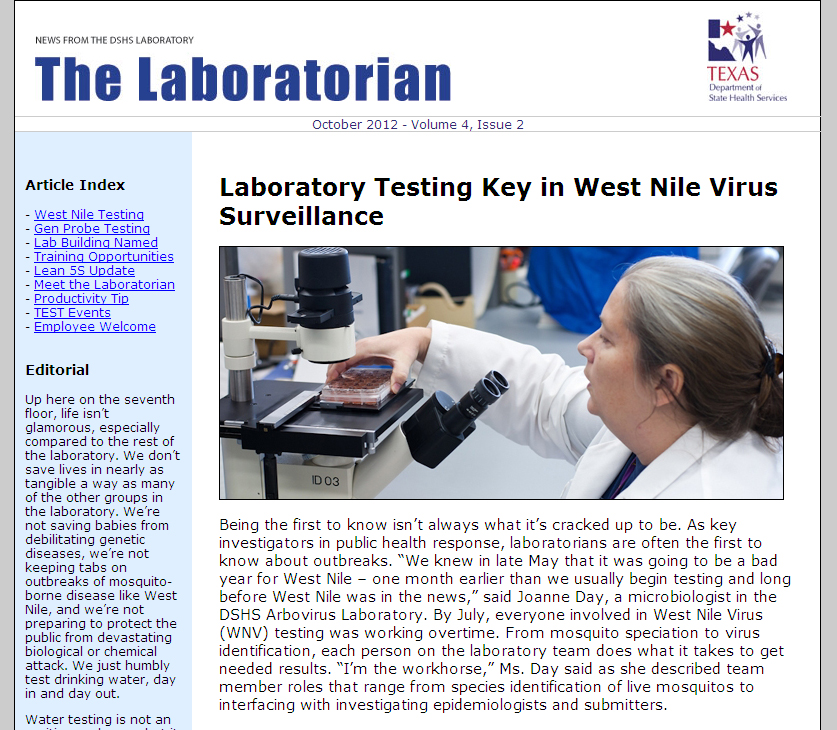
My Newsletter: West Nile Virus, Gen Probe testing, and new building name

Click here to read the October 2012 issue of The Laboratorian.

"Laboratory Testing Key in West Nile Virus Surveillance" was one of the most difficult articles that I have written for The Laboratorian — mostly because of the dearth of interview subjects. I don't really blame them. Being involved in outbreak response makes for long, intense days. Even though I felt like I was extracting material one tiny grain at a time,  information did gradually trickle in. A couple of people even agreed to be quoted. They were duly interviewed on the phone, via email and in person. Their contributions made a significant improvement by allowing me to include more than "just facts," for which I am extremely grateful. Writing about West Nile turned out to be a great learning experience, and the result is one of my favorite newsletter articles to date.

In comparison, the article titled "Laboratory Building Named for Former Legislator" came together quickly. My sources were willing and very helpful in providing information and verification via email.

The article on "Gen Probe Testing for Gonorrhea and Chlamydia" is the result of hard work by a member of my newsletter committee. Jan persevered in tackling a subject that often makes people squeamish. According to an old adage, “What you don’t know can’t hurt you.” As much as those of us who don’t like going to the doctor would like to argue, this is certainly not true in Public Health where diseases left undetected and untreated often lead to severe health problems.

Another member of my newsletter committee stepped out of his comfort zone to write the editorial on water testing. Andrew also willingly served as the photographer for many of the photos in this issue. I am extremely grateful for his help, which allowed me time to coordinate the numerous other details that go into a completed publication. Each issue brings its own behind-the-scenes challenges, and I couldn't do it without my dedicated group of volunteer committee members.

The layout of the publication is still lacking — due to limitations imposed by the work-in-progress that is our Web Content Management System — but the information is what really matters. I doubt that there are many out there scrutinizing it with my critical artistic eye.

Friday, July 13, 2012

Publications: Photo book and work newsletter on why newborn screening matters

Since my last post, I have been happily buried in publication projects both at home and work. My son's two year photo book is now finished! I carefully selected and edited each of the 65 pages of photos and printed via Picaboo. When my books arrived, I discovered that I had to re-edit and re-print due to a glitch in the newest Picaboo software (some images were improperly zoomed, resulting in faces being cut in half). It was a hassle to have to return to the project that I thought finished, but Picaboo was good to work with and I am very happy with the final result. Sometimes extra time with a publication is all for the good.

My work newsletter will be familiar to regular readers. This issue marks three years of publication for The Laboratorian, and it’s funny how important public health projects come back around. One year ago, my editorial focused on the Laboratory Newborn Screening (NBS) program, highlighting how we continue to work on “Improving Health Outcomes for Children”. Our NBS Laboratory—already the largest testing volume NBS program in the world—is adding another test to the current panel of 28 disorders. In 2011, we received 741,650 specimens, which is about 62,000 per month or 2,456 per work day. With the addition of Severe Combined Immunodeficiency (SCID) to the screening panel in Fall 2012, each newborn in Texas will be screened twice for 29 disorders. For more details, read the article on “SCID Coming Soon to Texas Newborn Screening Panel”. As our laboratory works toward this goal, we remember baby Cameron. For Cameron, newborn screening for SCID didn't come quite soon enought. (See below for "Why Newborn Screening Matters...")

I regularly lead Laboratory tours for new employees. Without question, the most visually interesting stop is the Parasitology Laboratory where various organisms are displayed in conjunction with fascinating stories by Team Lead Cathy Snider. Read the article on “Chagas Disease and Laboratory Diagnosis” to join in our show and tell.

Each year the Laboratory’s Emergency Preparedness Branch opens its doors to host Biosafety Level 3 (BSL-3) Training for members of the Laboratory Response Network. Read the article on "BSL-3 Students Learn to Work Safely" to understand the stringent training—from personal protective equipment to emergency procedures—needed to work in a BSL-3 laboratory. Despite my fascination with virology and this kind of high-security laboratory, I’m content to forego this as a tour stop. Here in the Laboratory, we take safety seriously.


Why Newborn Screening Matters...

Sometimes the value of public health laboratory testing is most apparent when vital tests are unavailable. Such was the sad case for baby Cameron, who was born in Texas on June 30, 2010 and died tragically on March 30, 2011, at just nine months of age.
 
Cameron and his older brother

Cameron was discharged from the hospital as a normal, healthy newborn. Indeed, as the months went by, he was in the 90th percentile for height and weight, with no problems other than the ear infections that bother so many babies. But after getting tubes in his ears at seven months— just like his older brother, Gavin— Cameron developed cold symptoms that wouldn’t go away.

In February, 2011, he was hospitalized for pneumonia. But with his condition worsening, he was transferred one week later to a specialty hospital for advanced care. Within hours of his arrival, doctors induced coma to stop what appeared to be seizures. His mother, Jennifer, said, “We would not get to hold Cameron in our arms again for over four weeks, until the last moments of his life.”

During those heart-wrenching weeks, Cameron endured CAT scans, MRIs, EEGs, spinal taps, blood transfusions, massive doses of antibiotics, antiviral agents, antifungal agents and other medications. He was treated by critical care providers, pediatricians, neurologists, epileptologists, toxicologists, immunologists, infectious disease physicians and respiratory therapists.

After ten interminable days, Cameron was diagnosed with severe combined immune deficiency (SCID), also known as “bubble boy disease.” In effect, he had no working immune system. Like many infants with SCID, Cameron’s family had no history of the disease. Moreover, Cameron exhibited none of the most common symptoms, such as failure to thrive.

“Point blank,” said Jennifer, “Cameron did not fit the profile of a SCID baby.”

And here’s where the tragedy is compounded: SCID is readily detectable at birth, with a newborn screening test that costs about $6. But while Cameron was tested for more than two dozen newborn screening disorders, at the time of his birth the SCID test was available only through two pilot programs, one in Wisconsin and the other in Massachusetts. Based on the results of those efforts, on May 21, 2010— when Cameron was not quite two months old— the US Department of Health and Human Services added SCID to its core panel of genetic disorders recommended for state-based newborn screening.

This momentous development came too late for Jennifer’s “dear, sweet Cameron.” If a baby with SCID receives a bone marrow transplant within the first 3.5 months of life, the survival rate is as high as 94%. But at nine months old, Cameron was already too ill for a transplant. In a last desperate measure to save his life, physicians performed a brain biopsy to try to identify the infection that was attacking him so fiercely.
Jennifer said her son went into a coma, “not to wake again.”

“I cannot begin to describe to you,” she said, “the heartache and helplessness a parent feels after losing your child, your baby, and you do not even know exactly what stole him from you.”

For want of a $6 newborn screening test, Cameron endured over $830,000 worth of medical care. The cost of his funeral was over $3,800.

Fortunately, thanks to the work of state public health laboratories and partners in Wisconsin and Massachusetts, SCID screening has been shown to be practicable and cost-effective. Today, many states— including Texas— have pilot SCID screening programs, with the intent of adding the disorder to their routine newborn screening test panels so babies like Cameron can be saved. In fact, Jennifer now volunteers with the Texas health department, educating other parents about the importance of newborn screening.

Altogether, state public health laboratories perform or oversee the screening of 97% of babies born in the US each year, testing for more than two dozen conditions, which, like SCID, can result in death or disability if not treated soon after birth.

Of the 4.5 million US babies screened annually, over 4,000 screen positive for a genetic or metabolic disorder. With early diagnosis and treatment, these babies have a better chance of leading long and healthy lives.
Originally published in APHL Stories from the Field.

Monday, April 16, 2012

My Newsletter: Newborn Screening opt-in form, laboratory improvements, and more

Working on the April 2012 issue of The Laboratorian has been both challenging and rewarding. We tackled complex topics related to Newborn Screening, reveled in the blog article written by a lab tour participant, and completed a whole slew of articles related to improvements ranging from communicating test results, to internal document management, to improving efficiency.
  • New “Opt-in” Decision Form an Important Step for Newborn Screening
  • Communicating Newborn Screening Data Efficiently
  • The Secret (and Amazing) World of Public Health Laboratories
  • Improving Laboratory Efficiency: Lean in the DSHS Laboratory
  • Laboratory Analytical Testing Auditors: Understanding Who, Why, and How
  • Introducing iPassport for Document Control

For internal circulation, we recognized employees for various achievements, including peer awards and service awards. I asked each member of my Newsletter Committee to answer five questions for the enjoyment of our co-workers. I'm very proud of the hard work of everyone involved! This issue was very nearly a laboratory-wide effort that also necessitated correlating web updates.

Here, for your amusement, are my answers to the same questions that I asked of my committee. Hopefully this will keep you entertained for the day or two it will take until I can post a link to our newest issue.

Click to enlarge

Edit: The Laboratorian, April 2012, is now posted here.

Thursday, March 22, 2012

New face mask inactivates flu viruses

Not much blogging has been happening amidst the rush of preparations for my son's birthday (how can he be turning two already?!), but I have been keeping an eye on flu-related news.

Yesterday a company called Medline put out a press release advertising their new face mask; it inactivates 99.99 percent of flu viruses. After a brief smile at the name, BioMask (which brings to mind the original working title of my novel: Biomass), I focused on the really interesting part. Instead of just filtering particles, the BioMask actually kills flu viruses. The following is a quote from the press release about how this works.

The Curad® BioMask™ works by using a combination of citric acid, zinc and copper — all powerful but safe ingredients. A hydrophilic coating on the outside quickly wicks droplets into and away from the outer surface. Viruses are inactivated on this outer layer by exposure to citric acid, which creates a low pH environment. The droplet then lands on the mask’s inner blue layer where influenza viruses are inactivated by copper and zinc, which are toxic to pathogens.
Testing included at least nine strains of flu, which were all inactivated within five minutes of contact. The makers also tout the minimization of cross-contamination. Cross-contamination is a big consideration in viral spread. If you touch a door knob after coughing or sneezing into your hand, others who follow can pick up whatever nasty surprises you left behind. And we all touch our face—most notably for transmission our eyes, nose, or mouth—an estimated 3,000 times a day. (As scarily illustrated in the movie Contagion.) Consider this another plug to wash your hands.

I can't really see the public adapting to constant mask-wearing, particularly without an imminent threat, but the BioMask should make a lot of medical personnel happy. 

All of this germ talk is yet another reason I'm happy to be escaping the child birthday party for one more year. We are going to to the zoo with family (no one can live in a bubble), and then we’ll head home for dinosaur cake (I'm baking/decorating) and quality time playing on son's new swing set. Of course, this proud mom plans to snap even more pictures of her growing boy.

Friday, March 9, 2012

The secret (and amazing) world of public health laboratories

My job position is so much of a mouthful that I am often met with blank stares when I answer a question about my work. Even the shorter version, my title of Information Specialist, doesn't have quite the same level of recognition as teacher or nurse.
In my case, Information Specialist means that I translate highly technical information in order to create and revise web pages and publications related to the work of our laboratory. For a look at the work I support, read the blog post from which I borrowed my blog title. This is one of those pieces of writing that immediately tweaks a sense of "why didn't I write that?" In this case I think that I'm a bit too close to the work, but I'm totally tickled that Kim Krisberg toured our laboratory and took the time to write an excellent blog post.


Walking around a public health laboratory is seriously cool.

Giant humming machines, rows of test tubes and small, round dishes containing specimens with hard-to-pronounce names, biohazard warnings and emergency shower stations, an egg incubator and liquid nitrogen generator, people in protective gear with bulky white hoods and face shields. Oh, and boxes with severed animal heads inside.

Click here to read more.

Thursday, January 12, 2012

My newsletter: Cantaloupe, laboratory improvements, and son as model

I am excited to announce that I just published the January issue of my newsletter. I always have so much fun working on it; the days just fly by as I compile articles, information, and photos and edit them in order to build the web page for online publication. Pardon me while I do a happy dance. Here's my my editorial to keep you busy meanwhile.

My son’s favorite fruit is cantaloupe. I have often grabbed bites for myself as I washed, seeded, skinned, and diced. Perhaps, like me, the sweet, earthy scent evokes summer, bringing back memories of swim-enhanced appetite slaked by devouring the orange flesh straight from the rind, juice dripping toward your elbows. The recent food outbreak linked to cantaloupe stole some of my heedless joy in cantaloupe consumption. What if my son had been exposed to the bacteria that caused such wide-spread illness and even death? Fortunately, his window of danger is long past, along with cantaloupe season, but I know that I’m not the only one who will scrub next summer’s cantaloupes with added vigor.  Read the article on “Investigating Listeriosis” to learn about the important work of public health laboratories as we work to solve food outbreaks.

As we begin the New Year, our Newborn Screening (NBS) and Blood Lead Screening programs continue their contributions to our on-going resolution: improve health and wellbeing in Texas. NBS is working to enhance the processes used in screening each baby born in Texas, and the Clinical Chemistry Group is working on internal and external improvements. You can read more about their progress in “Presenting NBS and Clinical Chemistry Process Improvements.”

Delve deeper into one of our improvement methodologies in the article on “Improving Laboratory Efficiency: Implementing Lean Six Sigma Principles.” This tool helps us overcome challenges in order to maintain high quality laboratory testing and improve customer and employee satisfaction.

A safety article on Preventing Slips, Trips, and Falls was also included in the employee edition. We used a photo of my son as an illustration on how we learn to walk. I just have to be the proud mom for a moment (see photo below). He was exploring one of his favorite places, aka outside, and in this case our back yard.


Son, hubby, and I also explored a nearby playscape. I challenge you not to smile at this photo:

Thursday, December 29, 2011

Cocooning: A vaccine strategy to protect infants

Son after immunizations (4 months old)
I just learned a new way to use a familiar word. Cocooning is the strategy where close family members of infants are vaccinated to protect infants who are too young to get shots themselves. Babies have to be at least six weeks old to get vaccines like TDaP and six months old to get the flu shot.

My husband and I tried to institute a smaller version of cocooning when our son was born. We asked that all family members make sure that they were current on their vaccines, with particular note paid to more rare immunizations, like the one for pertussis (whooping cough). Our request was only partially successful.

Cocooning is backed by the CDC, as evidenced in many of their vaccine recommendations that adults who have close contact with infants should also get a dose of _____ (recommended vaccine). However, not much research has been done on the practice.

One barrier to the use of cocooning is the hefty price tag. Canadian government researchers estimated that preventing one infant death would require vaccination of at least one million parents. American Academy of Pediatrics (AAP) reports on cocooning, released in the journal Pediatrics, do not directly recommend that pediatricians start offering shots to parents. "What it says is, if you choose to do it, this is OK," said the AAP's Dr. Herschel R. Lessin, who worked on the report.
"The goal here is to get everyone immunized," said Lessin. "As pediatricians, we think immunization is the greatest thing in the history of mankind."

Lessin acknowledged that there isn't much evidence on how effective cocooning really is. "It's a relatively new concept," he said. "I don't know that anyone has looked at whether it works." The Canadian study, published in the journal Clinical Infectious Diseases, takes a stab at that, although it's based on calculations instead of an actual experiment.
From past research, Skowronski and her colleagues estimated that whooping cough in infants could be blamed on parents passing the disease along some 35 percent of the time. (from "Cocooning: Doctors Divided on Vaccine Strategy to Protect Babies")
I think it's a simple enough thing to add myself and my family to the ranks of the well-vaccinated. Each person vaccinated creates a small but important measure of protection for themselves and those around them.

Tuesday, November 29, 2011

Shop healthy: Combatting the eight germiest places in the mall

Here's my contribution to your safe and healthy holiday season. 
Avoiding viruses and bacteria that cause colds, stomach bugs, and flu starts by arming yourself with knowledge. Stashing a few sanitizers helps too. During this hectic time of year, it pays to slow down and pay attention to a few small steps that can save you a lot of recovery time.

CNN Health ran a story on the "8 germiest places in the mall." Below are the highlights:
  1. Restroom sinks - The filthiest area in the restroom is the bathroom sink. Stay aware of the type of soap dispensers (are they refillable?) and wash your hands thoroughly. Use a paper towel to turn off the water and open the door. If any of these things are not available, follow up with at least a tablespoon of alcohol-based hand sanitizer.
  2. Food court tables - Stash a pack of hard-surface disinfecting wipes so that you can clean the table before you sit down.
  3. Escalator handrails - Avoid touching handrails. If you absolutely have to, follow with hand sanitizer.
  4. ATM keypads - Knuckle ATM buttons to avoid getting germs on your fingertips, where they are more likely to transfer to your nose and mouth, and follow with hand sanitizer.
  5. Toy stores - If you make a purchase, wipe down any toy not in a sealed package with soap and water, alcohol, or vinegar before giving it to your child. Also, use your hand sanitizer after touching things in the toy isle; that goes for your child too.
  6. Fitting rooms - The clothes you try on are the germ culprit here. When trying on clothes, always wear full-coverage underwear and bandage cuts or scrapes before trying on clothes. Be sure to wash new clothes before you wear them.
  7. Gadget shops - Avoid transferring germs from the people who tested the new smartphone before you by quickly wiping it down with a disinfecting wipe. Once again, use a hand sanitizer when you're done.
  8. Makeup samples - Avoid public makeup samples. Ask for a single-use unit. If that's not available, use a tissue to wipe off the sample and then apply the product to the back of your hand. Even better, buy the product before you try. Returning is more hassle but also a lot safer.
I'll add my own tip: Shop online from the comfort and safety of your own computer. If you can't do that, or if you prefer the hustle and bustle of the holiday shopping mall experience, take a deep breath, grab your sanitizer wipes and hand sanitizer, and enjoy. Above all, don't forget to slow down enough to enjoy quality time with your family; that's what the holidays are all about.

Friday, November 11, 2011

World's first simulation of complete H1N1 influenza virus

Happy 11/11/11 and happy Veteran's Day! Here's some food for thought, before you head off to whatever activities you have planned to celebrate the occasion.

Scientists in China have created the first computer simulation of the complete H1N1 influenza virus, down to the atomic level. This is a major break-through was announced just yesterday. Until now, studying viruses in the laboratory has been challenging because reactions occur too quickly to observe. 

Supercomputer

Simulating billions of particles in the correct conditions was no small feat. The researchers, at the Institute of Process Engineering of Chinese Academy of Sciences, used over 2,200 Tesla GPUs to power the Mole-8.5 supercomputer.

I suspect that the technology will need fine-tuning, but the possibilities are exciting. Using the H1N1 simulation, and others like it, scientists will be able to perform new research—an important step in developing more effective ways to control epidemics and create anti-viral drugs.

With this kind of detail for a virus, I can imagine a future where computers will have enough processing power to create a realistic simulation of places and even people. Perhaps someday my son will visit a real holodeck.

Tuesday, November 1, 2011

Drinking water can help children lose weight

Son with Camelbak (9mo)
I try to make sure that my son always has a source of cold water available, just like I keep my own water supply handy. (He even has a CamelBak 0.4-Liter Kids Bottle, like Mommy's and Daddy's CamelBak 0.75-Liter Better Bottle.) Now I have an additional reason to continue the practice.

According to a study published in the International Journal of Obesity, Children who drink water demonstrated an increase of up to 25 percent in resting energy expenditure (REE). The study size was small (21 overweight, but otherwise healthy children) but the findings reinforce the concept that the increased water-induced REE could assist overweight children in weight loss or maintenance. The conclusion: adding a water-drinking emphasis to dietary guidelines could help fight the obesity epidemic.

Researchers were inspired by previous studies that "demonstrated that drinking water significantly elevates the resting energy expenditure (REE) in adults, and that low water intake is associated with obesity and lesser success in weight reduction." That's all I need to reinforce the benefits of drinking water in adults. I can use all the help I can get!

Monday, October 24, 2011

Deadly Black Death bacteria hasn't changed, but we have

This is a follow-up to my previous blog, Black Death revealed and how research leads to preparedness. I recommend that you use the link above to read that blog first, for more details on the topic of this blog. If you have already done so, please proceed with your reading.

According to a journal article published earlier this month in Nature, the first genome sequence of an ancient bacterial pathogen has been completed. Yersinia pestis was extracted from the teeth of victims buried in a medieval cemetery. The results of the sequencing are really interesting.... Y. pestis, which caused the bubonic plague called the Black Death, hasn't really changed. There are only a few dozen changes among the more than 4 million DNA building blocks.

Before you get scared, you might want to refer to the title of this blog. The bacteria hasn't changed, but we have. Whew! Apocalypse averted, right?

The Black Death was deadly because of a combination of circumstances. In 1348, the climate was getting colder, the world was in the midst of a long war and horrible famine, and people were moving into closer quarters. All of these factors contributed to give the disease easy reach for infection and spread. In addition, people did not have any innate immune response; this was the first time the disease had attacked humans.

Today, simple antibiotics, such as tetracycline, can beat the bacteria. Interestingly, Y. pestis does not seem to have properties that enable other germs to become drug-resistant. Combine that with improved medical treatment, preparedness, and response by the health community, and we're set to avoid another plague-driven apocalypse...at least where the Black Death is concerned.

Other possibilities, both bacterial and viral, remain open for speculation by science fiction writers with vivid imaginations. Take the flu, for example....

Tuesday, October 18, 2011

Debunking flu myths: Why you should get your vaccination now

I hope that you'll allow me to step back onto my vaccination soapbox for a moment.

I just read a news story that chilled this mother's heart. Four-and-a-half-year-old Amanda Kanowitz was healthy until she began to show her first symptoms—cough, low fever, and vomiting. Her doctor suspected a common childhood bug and recommended fluids and rest. Three days later, her parents found her lifeless in her bed.

Amanda had the flu. Seven years ago, when she died, doctors did not recommend shots for kids her age. That has changed. Now the CDC recommends flu shots for everyone over 6 months old.

I hate to be the one to pass along such a sad story, but I am doing so in the hope that it will help save lives. Only 43% of Americans got a flu shot last year, and that was a record year. The article that I read, on how to "Separate the facts from flu fiction," ran through several common flu myths. I'll highlight two, but I urge you to read the article for more information.

Myth 2: The flu shot causes the flu.
About 35% of consumers think the flu vaccine can cause flu, CVS found. But that's impossible, CDC says, because the viruses in the flu shot are dead. Its most common side effect is a sore arm. Mist nasal spray contains weakened viruses, so they don't cause severe symptoms, either. Side effects in kids can include a runny nose, wheezing and headache.

Myth 4: Only sickly people need a flu shot.
Half of consumers think flu shots are only for kids or sick people, CVS found. Actually, the most vulnerable members of society, such as newborns or those with weak immune systems, often can't get flu shots. The only way to protect them is to vaccinate everyone around them, keeping flu viruses out of circulation, Bergen says. Because babies can't be vaccinated until they're 6 months old, they depend on vaccinated friends and family members to create a "cocoon" of protection, Bergen says.
I'm sure that you have already read my past blogs on the flu and vaccines (right?), but on the off chance that you haven't, here's a link to my posts on vaccination. If you still need to get your flu shot, please go to your nearest pharmacy (many of them are located in your local grocery store) and take a few minutes to protect yourself and your loved ones. If you have already received your flu shot, here's a big THANK YOU from me and my family.

Monday, October 3, 2011

The beginning of the end for the flu virus?

Vaccines have been the weapon of choice against viruses, and I have talked about them here on several occasions. Now research is exploring a new therapy: an antiviral drug called Double-Stranded RNA Activated Caspase Oligerizer (DRACO). Catchy name aside, what does DRACO do? It targets cells that have been infected by a virus, hunting the signature mechanism by which viruses reproduce.

The majority of viruses reproduce in four steps:
  1. Fixation and entry of the virus into the targeted cell.
  2. Copy the genes of the virus using the cell’s power.
  3. Bundling of virus particles.
  4. Emergence of many copies of the new virus to spread the infection to other cells.
Dr. Todd Rider and his colleagues from the Massachusetts Institute of Technology, are targeting the second step in the viral reproductive process. When their genetic material is copied inside the cells, the virus produces a structure called “double-stranded RNA”; because this unique structure is missing in non-infected cells, a protein tied specifically to the double-stranded RNA allows for the specific targeting of the cells containing the virus. By combining this protein with another protein that triggers cell death through apoptosis, it becomes possible to eliminate the infected cells without any side effects on the healthy cells.

Still with me? In short, DRACO targets cells with long strings of double-stranded RNA, causing them to commit cell suicide while ignoring the other healthy cells.

Dr. Rider's research has been tested on 15 different viruses, including H1N1 influenza, and it was effective against them all. The possible catch is that this research was primarily conducted on mammalian cells cultured in a lab, which leaves the possibility that the drug might not work on living animals. More recent work on the drug's effect on mice infected with influenza has continued to yield promising results.

If perfected, DRACO could revolutionize the treatment of viral diseases. Vaccines are effective, until the virus mutates. An antiviral drug could continue to work when vaccines fail. More research and time is needed to determine whether the new treatment is safe and effective for treating viral infection in humans.

Friday, September 23, 2011

Sneak peak at real life public health virus prevention projects

I'm hard at work on finalizing the next issue of my public health newsletter, so I thought I'd make the most of my creative energy and post a couple of opening paragraphs that I wrote for included articles. Both deal with viruses.

Influenza Incidence Surveillace Project: Preventing the Next Pandemic

The deadly 1918 “Spanish” flu circulated silently in the United States for four months before anyone noticed it. As frightening as that sounds, given what we know now about the strain of influenza that killed up to 50 million people worldwide, it is actually good news. Better surveillance now means that we will have enough notice to stop the spread of a novel flu strain before it becomes a pandemic. That is why the Laboratory is working on a national surveillance project with the Emerging & Acute Infectious Disease Branch. This project will monitor the age-specific incidence of medically attended influenza-like illness and influenza.

The Rabies Laboratory: Never a Dull Day

Micrograph with numerous rabies virions
(small, dark-grey rod-like particles) and
Negri bodies (cellular inclusions)
 With 8,000-10,000 specimens received per year, work in the Rabies Laboratory is never dull. However, some days are more interesting than others. Laboratorians well remember receiving a tiger head for testing. Most specimens submitted are dogs and cats. Bats come next, in order of decreasing appearance, followed by skunks and just about everything else, including cows, horses, squirrels, armadillos, and raccoons. All mammals are accepted for testing, but everyone takes notice when the specimen is a zebra, gazelle, wildebeest, or nilgai.

What is a nilgai? The rabies team here had to look that one up too.

Wednesday, September 14, 2011

Get your flu vaccination now

It's time to schedule your flu vaccination.

Most of us think of flu clinics as we head into October and the weather cools, if we think of them at all. It's still in the triple digits here, but I already have my flu vaccination scheduled (September 27). Unlike the 2009 H1N1 pandemic, this year flu vaccine stocks are plentiful and health departments are urging early vaccination.

The CDC recommends that everyone six months and older should get the flu vaccine each year. I most definately agree. At the forefront of my memories are the last time that I was sick with the flu (in college I was so weak after that I couldn't walk to my class across campus) and my personal experience of what happens when vaccine is not available. My son will be getting his vaccination at the end of the month, during his Well Child visit.

Please help contain this preventable disease by making vaccination a priority. A simple shot or nasal spray can protect your family, friends, and acquaintances, particularly the little ones who can't make this important health decision for themselves.

Wednesday, September 7, 2011

Black Death revealed and how research leads to preparedness

Yersinia pestis
The 1348 Black Death plague was one of the worst pandemics in human history; it killed about a third of Europe's population (30-50 million) in only five years. Recent scientific advances have allowed anthropologists to identify and study the bacteria responsible, a now extinct strain of Yersinia pestis.

DNA testing on the skeletons of 109 plague victims, unearthed in a medieval London mass grave, reveals part of the same gene sequence as the modern bubonic plague, despite its different attributes. The modern strain still causes about 2,000 new cases of bubonic and pneumonic plague each year.

Rather than using polymerase chain reaction (PCR), the common genetic technique used for forensics and DNA testing, scientists used very new techniques: targeted enrichment and high-throughput sequencing. These techniques allow researchers to reconstruct long sequences of ancient, damaged DNA that have degraded over time. It's like creating a window back in time, though on a miniscule scale.

Science has taught us much about transmission and containment methods, but this does not answer all of the questions about why the 14th century Black Death plague was so virulent. Fleas commonly carry Y. pestis from host to host, and the jump from rats to humans is often a short one. However, that transmission method doesn't account for such rapid spread, despite lack of public health knowledge. Could the strain have combined with another pathogen to achieve such remarkable virulence? Researchers are hoping to tackle the answer to that question next. To do so, they will attempt to sequence the entire Black Death Y. pestis genome.

I am constantly amazed at how rapidly expanding scientific technologies allow us to gather information that would not have been accessible a mere handful of years ago. For example, when I started researching the 1918 Influenza Pandemic, scientists had not yet reconstructed the virus. In an effort to advance preparedness, CDC scientists completed the reconstruction in 2005.

Why is it important to reconstruct a virus from the past? The work provides information about the properties that contributed to the exceptional virulence of that particular virus strain. This information is critical to evaluating the effectiveness of current and future public health interventions, which can be used when a 1918-like strain reemerges, either naturally or through deliberate release. To gain a sense of what could happen in such a flu pandemic scenario, you might want to read Dormant, which is still scheduled for release in early 2012.

Wednesday, August 24, 2011

Good news for toddlers getting their flu vaccine

Nasal spray vaccine
Nati Harnik/Associated Press
Good news for children under three years! Toddlers receive the same protective antibody response from the recommended two doses of licensed seasonal flu vaccines administered through any of these methods:
  • Injected by needle
  • Inhaled through nasal spray
  • Provided through one dose of each, in any order

The goal of the study, funded by the National Institutes of Health (NIH), was to determine whether giving two types of vaccines works just as well.

Even better, the researchers found that the toddlers who received at least one dose of the nasal spray vaccine—a live, attenuated influenza virus vaccine (LAIV)—made a wide array of immune T cells. Stimulating broad T-cell responses may be important for protection against many diverse flu strains.

This is good news for parents as well. My son seems to bring home every bug that goes through his daycare, so it's good to know that we can help prevent at least one. Getting your little one vaccinated also protects their playmates, teachers, parents, and other caregivers. Please make sure that you talk to your doctor about immunizations. If in doubt, feel free to read some of my blogs on vaccines, particularly the one titled "Vaccines are a victim of their own success."

Monday, August 22, 2011

Should you drink your fruits and veggies?

This summer, my immersion blender is getting a workout making green smoothies as a breakfast option. My favorite blend includes yogurt, mango, spinach, orange juice, and milk. Ignoring the generous serving of homemade yogurt and splash of milk, would it be just as healthy to pop open a container of a fruit and vegetable drink, like V-Fusion? Should you drink your fruits and vegetables? I went searching for answers.

Pure fruit or vegetable juice (no sugar added) in moderation is a good thing. Real juice is full of vitamins, minerals, and health-protecting phytochemicals, and it's often fortified with calcium and vitamin D, and occasionally eye-, brain-, and heart-healthy DHA. But you do have to watch that you really are getting the twofer that you expect. For an example, I'll keep picking on V-Fushion—mostly because I have V-Fushion Light in my fridge right now. The manufacturer claims that an 8-ounce serving “gives you a full serving of vegetables plus a full serving of fruit.” The label states that an 8-oz serving contains ½ cup of vegetables and ½ cup of fruit, which is the equivalent to one serving each, per USDA. (The Light version contains only one combined serving of vegetables and fruit, not two.)

V-Fushion is made of 100 percent fruit and vegetables juices, but there is a difference between reconstituted juices (juice concentrate) and freshly squeezed. The vitamins C and E do allow the manufacturer to put an “antioxidant” label on the packaging. However, peach juice is not a peach and carrot juice is not a carrot. Even high-pulp juices can't make up for all the fiber and nutrients that get discarded with the skin and pulp during juicing. These are the components that help keep your appetite, blood sugar, LDL cholesterol, and blood pressure down.

That said, vegetable-infused juices are better than no vegetables. At least it's a sweet beverage with fewer calories and more nutrients than soda or fruit punch. Drinking fruity, sweet drinks will not help turn my son into the veggie lover of my dreams, but neither will my beloved smoothies. That said, my immersion blender won't get a rest in the near future. We aren't going to turn into Popeye, but at least I know that we are getting good fiber and nutrition in our morning smoothies.

Friday, August 19, 2011

Homeopathic flu remedies top the list of "12 Things You Should Stop Buying Now"

Here's an interesting flu tidbit that caught my eye today. Homeopathic flu remedies top the TIME's list of "12 Things You should Stop Buying Now." The CDC's recommendations on Preventing Sesional Flu Illness includes the following statement: "There is no scientific evidence that any herbal, homeopathic or other folk remedies have any benefit against influenza."

While I don't know if green tea is used in homeopathic remedies, I believe that the studies are focusing on tea as a preventative versus a treatment. If nothing else, drinking tea can lend a certain comfort factor to help you feel better. That said, I wonder if the ongoing research into green tea as a flu preventative will be included in future recommendations.

Meanwhile, it would certainly be worth your time to review the CDC's guide on Good Health Habits for Preventing Seasonal Flu.